> For the complete documentation index, see [llms.txt](https://docs.itranslator.app/llms.txt). Markdown versions of documentation pages are available by appending `.md` to page URLs; this page is available as [Markdown](https://docs.itranslator.app/amazing-features/statistics.md).
# Statistics
Follow your translation activity, and export it.
Statistics show how much your server translates: per day, week or month, for the whole server or for a single channel. They are useful to follow your usage on every plan.
Statistics in Discord
## Where to find them
{% tabs %}
{% tab title="Dashboard" %}
Open your server in the [dashboard](/fundamentals/dashboard.md). The **Overview** page shows the characters used, the lifetime totals and the **Translation activity** chart, with its total, peak and average.
Three filters sit above the chart: **Data Type**, **Time Period** and **Channels/Categories**.
{% endtab %}
{% tab title="Command" %}
Run `/stats generate`. iTranslator answers with a chart and buttons to change the period or export the data.
| Argument | Description | Optional |
| ---------- | ------------------------------------------------------------- | -------- |
| `type` | The [data type](#data-type) to display. | No |
| `specific` | A channel or a category. Leave it empty for the whole server. | Yes |
`/stats help` displays a summary of the feature. Both commands require the **Manage Server** permission.
{% endtab %}
{% endtabs %}
## Data type
Two types of data can be analyzed:
* `TRANSLATED_MESSAGES`: the number of messages processed by iTranslator.
* `TRANSLATED_CHARACTERS`: the number of characters billed by iTranslator.
In the dashboard they are the **Messages** and **Characters** buttons.
{% hint style="info" %}
Would another data type be useful to you? Tell us on our [Discord Server](https://discord.itranslator.app/).
{% endhint %}
## Period
By default the statistics cover the last day. The period can be extended to the last week, month, quarter or year.
* In the dashboard, use the **Time Period** menu.
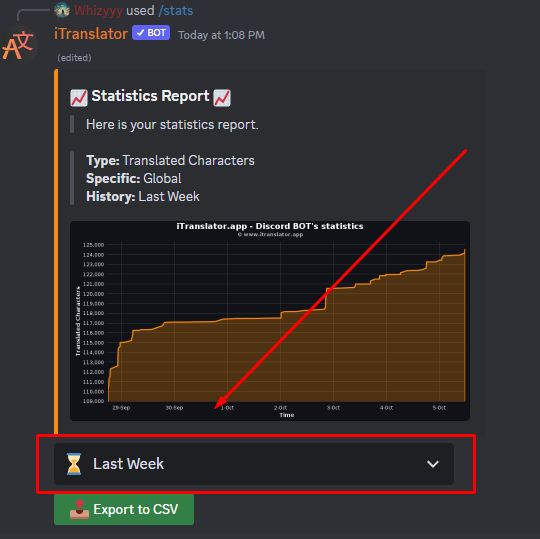
* In Discord, use the **History Type** button under the chart. The period you choose is also applied to the CSV export.
The History Type button
{% hint style="info" %}
Changing the period requires [**Premium**](/overview/premium.md). Free servers see the last 24 hours.
{% endhint %}
## Whole server, category or channel
Statistics can be limited to what you are looking for: **the whole server**, a **category** or a single **channel**.
* In the dashboard, use the **Channels/Categories** menu ([Premium](/overview/premium.md)).
* In Discord, fill in the `specific` argument of `/stats generate`. Leave it empty for the whole server.
## Export data to a CSV file
{% hint style="info" %}
The CSV export requires [**Premium**](/overview/premium.md).
{% endhint %}
To analyze the data your own way, run `/stats generate`, adjust the settings with the buttons, then click **Export to CSV**. The file is generated with your current settings.
The Export to CSV button
The file has two columns:
| timestamp | value |
| -------------------------- | ------------------------------------ |
| The date of the data point | The number of messages or characters |
---
# Agent Instructions
This documentation is published with GitBook. GitBook is the documentation platform designed so that both humans and AI agents can read, navigate, and reason over technical content effectively. Learn more at gitbook.com.
## Querying This Documentation
If you need additional information that is not directly available in this page, you can query the documentation by asking a question.
Perform an HTTP GET request on the following URL with the `ask` and `goal` query parameters:
```
GET https://docs.itranslator.app/amazing-features/statistics.md?ask=&goal=
```
`ask` is the immediate question: it should be specific, self-contained, and written in natural language.
`goal` is what the user is ultimately trying to achieve, the reason they need the answer. Sharing it helps GitBook give you a better, more relevant answer. A goal is most helpful when it describes the outcome the user wants rather than restating the question. For example, with `ask=how do I create an API token`, a goal like `automate deployments from our CI pipeline` lets GitBook tailor the answer to that use case.
The response will contain a direct answer to the question and relevant excerpts and sources from the documentation.
Use this mechanism when the answer is not explicitly present in the current page, you need clarification or additional context, or you want to retrieve related documentation sections.